
Process CSV Jobs with jev-table and Review Queues
Produce a resumable batch with row-level review and exportable results.
Use caseBatch a cleaned CSV, preview cost, and retain row-level results
A guided read of jev-table: preview cost, process rows, review exceptions.
Source · dtduc-git · Open-source guide
2026-09-21 · Editorial update; no live model call
Problem
Section titled “Problem”You want to learn from a working repository rather than copy an isolated snippet. This guide explains how to inspect the project, understand its permissions and choose a small first experiment.
A pack-based batch workflow CSV + pack → Dry-run → Authorized live run → Results / review / errors → IDs + versions
An estimate is not a bill or an accuracy result.
Before you begin
Section titled “Before you begin”-
Use a small fictional or authorized dataset. Do not paste private customer data into an unfamiliar service.
-
A current browser for reading. Check the linked project for its own runtime, access and cost requirements.
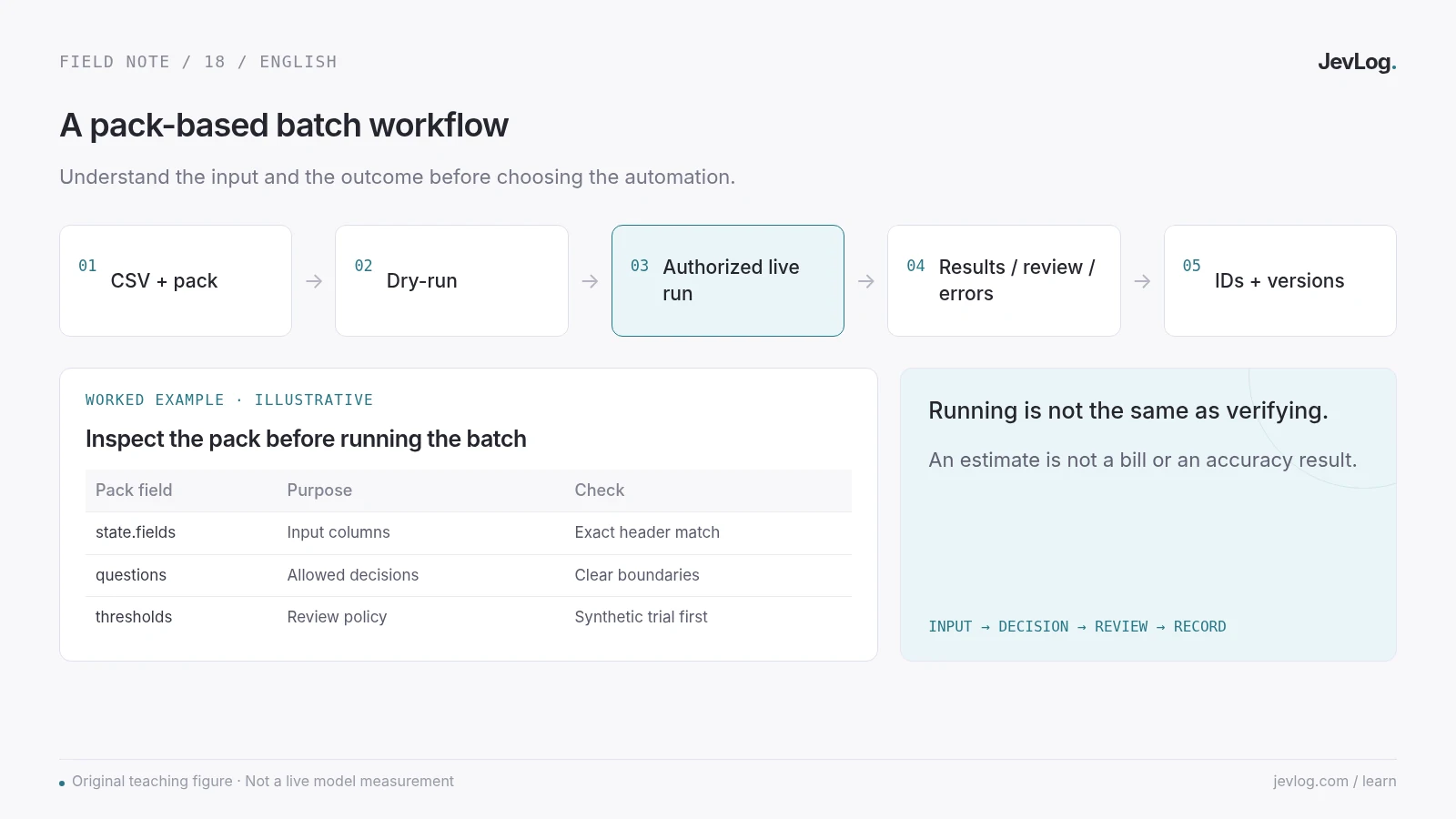
Original JevLog teaching diagram; not a screenshot of the source project or a measured model result.
1. Inspect the project and an example pack
Section titled “1. Inspect the project and an example pack”Review the README, Apache-2.0 code license and any separate data or pack license. Use its bundled example rather than a customer export for a first experiment.
2. Preview before sending data
Section titled “2. Preview before sending data”The documented –dry-run mode estimates the task without sending model requests. A successful preview is not a live quality test.
uvx jev-table messages.csv --spec pack.yaml --dry-run3. Understand the review output
Section titled “3. Understand the review output”Inspect the generated columns and threshold rules. Rows without an acceptable result must remain visible, not disappear. You decide whether and when to run against a paid endpoint.
4. Preserve the original file and IDs
Section titled “4. Preserve the original file and IDs”Keep outputs separate from inputs, compare processed/error/review counts, and record your pack and model versions. Review corrections before importing labels into another system.
Inspect the pack before running the batch
A pack defines which columns become state, which questions are asked, which options or levels are permitted and which policy routes results to review. Match state.fields to the actual CSV headers. Start with the repository’s bundled example and check code, pack and dataset licenses separately.
The documented dry-run estimates work without sending model requests. Inspect the selected rows and columns before opting into a live run. An estimate is not a bill or a quality result. Removing –dry-run changes the execution boundary and may incur model usage.
Read the result, review and error outputs as one accounting of the original inputs. Request deduplication must not delete legitimate events. Preserve original IDs and confirm that resuming a small interrupted batch behaves as expected before relying on it for a large workload.
Human corrections can become candidates for future checks, but they carry data rights and privacy obligations. Keep configuration and model versions, and do not publish customer text as an open task pack. Thresholds define your review policy rather than a universal correctness guarantee.
| Pack field | Purpose | Check |
|---|---|---|
| state.fields | Input columns | Exact header match |
| questions | Allowed decisions | Clear boundaries |
| thresholds | Review policy | Synthetic trial first |
| Version / output | Traceability | IDs and configuration |
Project-reading guide; no live run by JevLog.
Result and cautions
Section titled “Result and cautions”A small, inspectable experiment with its inputs, decisions and limitations recorded. This guide is not a production guarantee.
- A valid label can still be wrong. Keep a review path and keep irreversible actions outside the exercise.
- A community demonstration is not an independent benchmark. This collection does not reproduce the linked video or repository.
- You can identify the input, its source, and the fields that leave your system.
- Original identities, failed rows, uncertain cases and human corrections remain visible.
- You distinguish an offline fixture, an author demo and a live evaluation you ran yourself.
Source boundary: compiled from the linked public sources; not reproduced here. Review classifications before acting; they do not run actions automatically.
Related guides
Section titled “Related guides”Does request deduplication delete events?
Section titled “Does request deduplication delete events?”It should not. Verify every original ID in outputs.
Can I change the endpoint?
Section titled “Can I change the endpoint?”Check documented configuration, compatibility and authorization separately.