
Assess Jev-Like Open Models and Their Claims
A small, inspectable experiment with its inputs, decisions and limitations recorded. This guide is not a production guarantee.
Use caseAdd one narrow, explicit decision to code or a workflow
A reading checklist for community replicas, model weights and training claims.
Source · Vincent Wang-Maścianica · X companion
2026-09-21 · Editorial update; no live model call
Problem
Section titled “Problem”The author shares an independently developed Jev-like approach and points to code. Similar output shapes do not establish that a project uses TypeSafe’s weights, training recipe or quality.
Four distinct kinds of evidence Code → Weights → Licenses → Evaluation → Scoped conclusion
Similar outputs do not imply the same model.
Before you begin
Section titled “Before you begin”-
Use a small fictional or authorized dataset. Do not paste private customer data into an unfamiliar service.
-
A current browser for reading. Check the linked project for its own runtime, access and cost requirements.
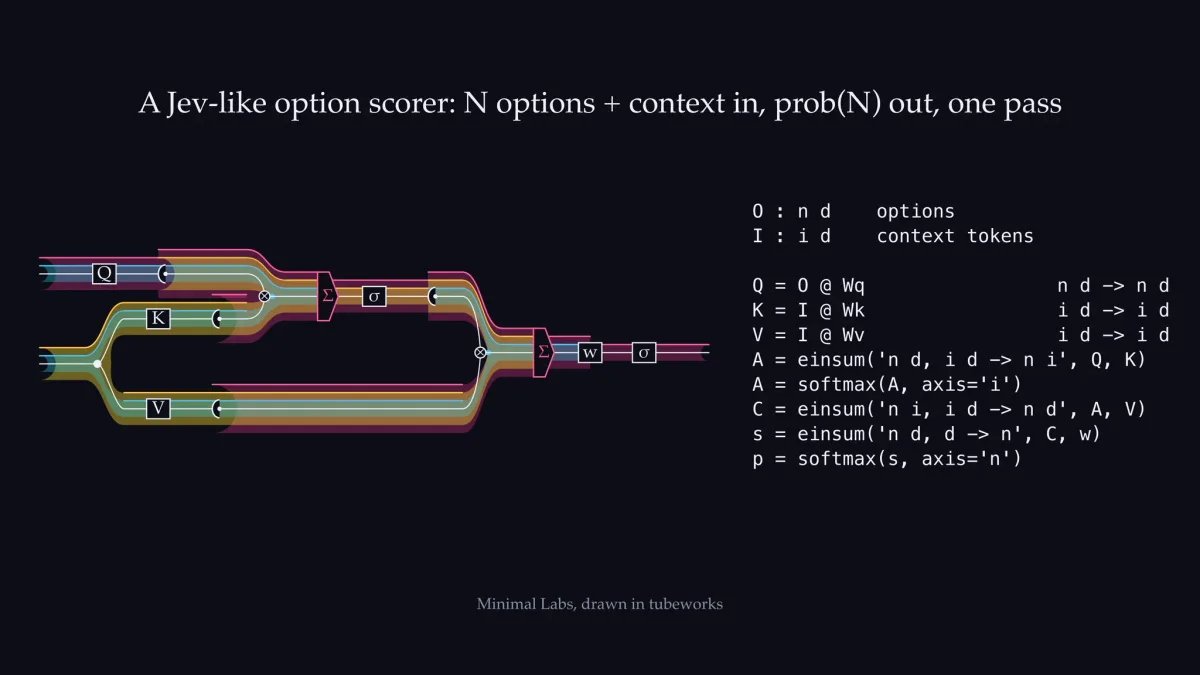
Image from Vincent Wang-Maścianica’s original X post. The post is linked; this is not a JevLog test result.
1. Keep the names distinct
Section titled “1. Keep the names distinct”Record which repository you are examining, which base model it uses and who maintains it. Label it an independent project, not an official Jev release.
2. Inspect what is actually provided
Section titled “2. Inspect what is actually provided”Look for runnable code, released weights, a license, hardware requirements and evaluation data. A diagram, paper summary or class with the right method name is not a working trained model.
3. Compare an identical task
Section titled “3. Compare an identical task”Use the same allowed outputs and held-out examples across alternatives. Check correctness, abstentions, latency and costs separately. Use comparable hardware and request boundaries.
4. Publish limits alongside results
Section titled “4. Publish limits alongside results”Document what you ran and what you only read. Do not turn the author’s “reverse-engineered” wording into a verified claim about TypeSafe’s internals.
Separate code, weights, compatibility and evidence
A repository can contain an architecture, a training recipe, an inference adapter or released weights. These are different deliverables. Record the maintainer, base model and exact components present before calling a project an open model. Training code alone is not evidence of trained quality.
An API that returns Choice-like values may be useful for experimentation, but similar response shapes do not establish identical weights, training, calibration or task performance. Check code, data and weight licenses separately. A locally runnable implementation still has hardware and maintenance costs.
For a comparison, use the same held-out records, allowed labels and quality requirements. State whether timing includes networking and preprocessing, and retain failures and uncertainty. Publish code inspection, mock tests and actual inference as distinct evidence. The author’s “reverse-engineered” wording should not become your claim about TypeSafe internals.
| Component | Evidence | Not established |
|---|---|---|
| Code | Source and entry point | Trained quality |
| Weights | Download + model card | Official provenance |
| License | Separate component terms | All uses permitted |
| Evaluation | Data + configuration | Your workflow quality |
No equivalence to the official model is claimed.
Result and cautions
Section titled “Result and cautions”A small, inspectable experiment with its inputs, decisions and limitations recorded. This guide is not a production guarantee.
- A valid label can still be wrong. Keep a review path and keep irreversible actions outside the exercise.
- A community demonstration is not an independent benchmark. This collection does not reproduce the linked video or repository.
- You can identify the input, its source, and the fields that leave your system.
- Original identities, failed rows, uncertain cases and human corrections remain visible.
- You distinguish an offline fixture, an author demo and a live evaluation you ran yourself.
Source boundary: compiled from the linked public sources; not reproduced here. Review classifications before acting; they do not run actions automatically.
Related guides
Section titled “Related guides”Does a repository mean weights are open?
Section titled “Does a repository mean weights are open?”No. Inspect each component separately.
Is local deployment free?
Section titled “Is local deployment free?”Compute, maintenance and other services still cost resources.