
Add Jev Decisions to RubyLLM Workflows
A small, inspectable experiment with its inputs, decisions and limitations recorded. This guide is not a production guarantee.
Use caseAdd one narrow, explicit decision to code or a workflow
Read a community Ruby integration before wiring it into an application.
Source · Kieran Klaassen · X companion
2026-09-21 · Editorial update; no live model call
Problem
Section titled “Problem”Kieran links a Jev integration for RubyLLM. This companion helps a Ruby developer review the integration contract without assuming a Python quickstart works unchanged.
A replaceable Ruby boundary Message → Ruby adapter → Provider call → Value / error → Existing approval
Do not turn transport errors into Other.
Before you begin
Section titled “Before you begin”-
Use a small fictional or authorized dataset. Do not paste private customer data into an unfamiliar service.
-
A current browser for reading. Check the linked project for its own runtime, access and cost requirements.
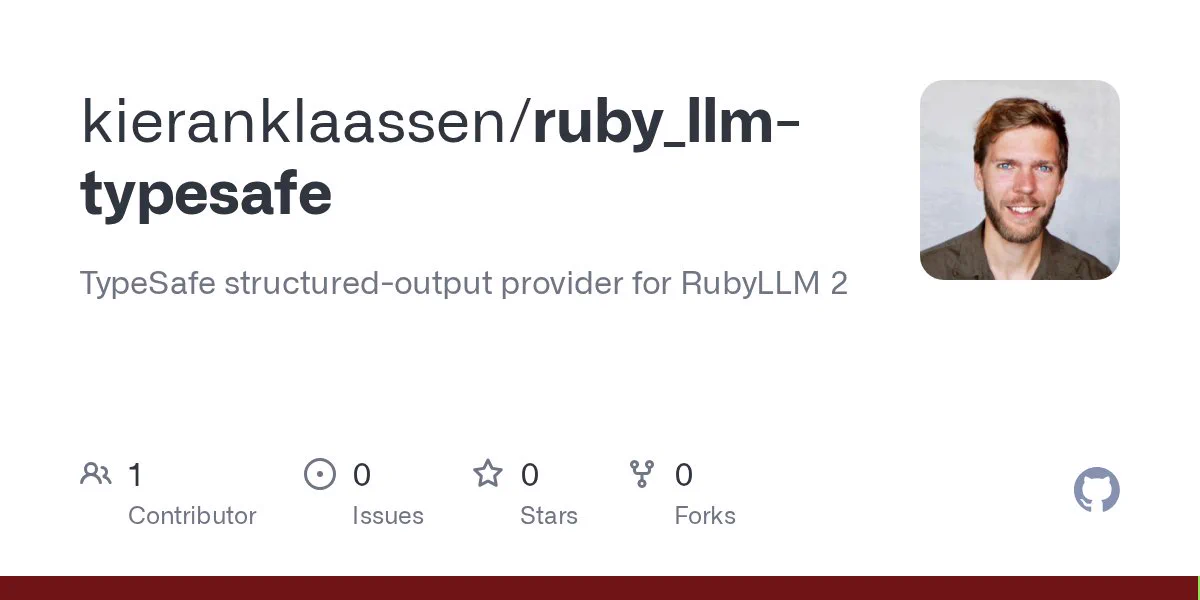
Link-card preview from Kieran Klaassen’s X post. The original post is linked; this is not a JevLog test result.
1. Start with the author’s repository link
Section titled “1. Start with the author’s repository link”Open the original post and follow its project link. Confirm the current package name, Ruby requirements and license before installing; this page does not invent a command for an unverified release.
2. Check the request shape
Section titled “2. Check the request shape”Inspect how the adapter represents state, questions, choices and errors. Compare it with the current TypeSafe documentation. Do not assume a chat-completions client accepts the same schema.
3. Use one fictional message
Section titled “3. Use one fictional message”Keep the key outside the code and start with one narrow category question. Inspect HTTP failures separately from an uncertain model answer.
4. Wrap it behind an application boundary
Section titled “4. Wrap it behind an application boundary”Make a small adapter with test fixtures and an explicit manual fallback. Keep a record of the package and model versions before putting the call on a user-facing path.
Keep the provider-specific details behind one adapter
An existing Ruby application does not need to become a Python project to add one decision. Start from the exact repository linked by the author, verify supported versions and licensing, and pin reviewed dependencies. This companion deliberately avoids inventing a gem name from an unverified announcement.
Define an internal input and result contract first. The adapter translates it into state, questions and provider-specific answer types. Do not assume a chat-oriented messages schema is interchangeable with a typed decision request. Validate missing input, unknown labels and response shape.
Authentication failure, rate limiting, timeout and genuine uncertainty should remain distinguishable. Mapping every exception to Other makes an outage look like a successful business classification. Keep suggestions separate from actions, and preserve the application’s existing approval and authorization path. Mock tests check the adapter; an authorized live sample checks the integration, and a labeled set is still needed for quality.
| Condition | Internal state | Next step |
|---|---|---|
| Allowed label | suggestion | Business checks |
| Missing text | invalid_input | Ask for input |
| Access denied | auth_error | Pause configuration |
| Ambiguous | needs_review | Human review |
Proposed internal contract, not a package API signature.
Result and cautions
Section titled “Result and cautions”A small, inspectable experiment with its inputs, decisions and limitations recorded. This guide is not a production guarantee.
- A valid label can still be wrong. Keep a review path and keep irreversible actions outside the exercise.
- A community demonstration is not an independent benchmark. This collection does not reproduce the linked video or repository.
- You can identify the input, its source, and the fields that leave your system.
- Original identities, failed rows, uncertain cases and human corrections remain visible.
- You distinguish an offline fixture, an author demo and a live evaluation you ran yourself.
Source boundary: compiled from the linked public sources; not reproduced here. Review classifications before acting; they do not run actions automatically.
Related guides
Section titled “Related guides”Must I change languages?
Section titled “Must I change languages?”No. Keep the integration aligned with your existing service.
Why no guessed gem command?
Section titled “Why no guessed gem command?”The exact published package was not verified in this review.